
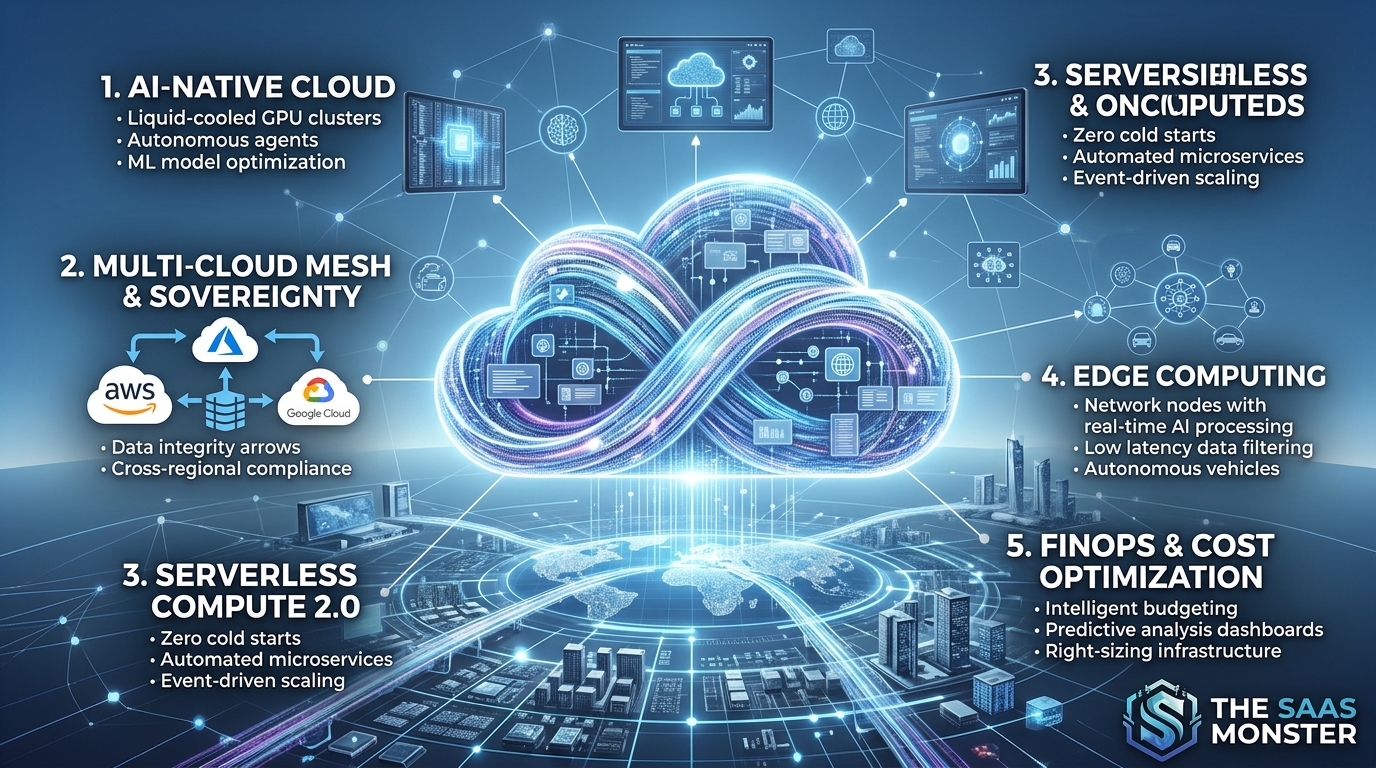
Cloud computing has officially entered a transformative era in 2026. What once served as a simple storage and infrastructure migration solution has evolved into an intelligent, decentralized backbone for global business. Driven by breakthroughs in artificial intelligence, edge computing, and complex multi-cloud ecosystems, cloud architecture is no longer just about operational efficiency—it is the core engine of corporate innovation.
For SaaS founders, IT leaders, and tech creators, navigating this evolving landscape is essential. Here is an in-depth look at the major cloud computing trends defining the technology stack in late 2026.
1. The Rise of AI-Native Cloud Infrastructure
The widespread adoption of generative AI and autonomous agents has fundamentally rewritten cloud hardware requirements. Traditional server setups are being rapidly replaced by high-density, AI-native cloud environments designed specifically to handle massive inference workloads and real-time model training.
Cloud providers are shifting toward specialized hardware configurations featuring liquid-cooled GPU clusters and proprietary AI accelerators. This shift allows enterprises to build, fine-tune, and deploy custom large language models (LLMs) with minimal latency and optimized power consumption.
2. Multi-Cloud Mesh & Sovereign Cloud Architecture
Relying on a single cloud vendor is increasingly becoming a strategic risk. In 2026, enterprise adoption of Multi-Cloud Mesh environments has reached an all-time high, allowing organizations to dynamically route workloads across AWS, Microsoft Azure, Google Cloud, and private clouds based on cost, performance, and compliance needs.
Alongside multi-cloud strategy, Sovereign Clouds have emerged as a critical requirement:
-
Data Residency: Governments worldwide now enforce strict data localization laws requiring consumer data to remain within physical national borders.
-
Localized Infrastructure: Cloud giants have expanded regional data centers to offer complete data sovereignty without sacrificing advanced cloud functionality.
3. Serverless Compute 2.0 & Event-Driven Microservices
Serverless architecture has evolved beyond simple event triggers into full-scale, zero-infrastructure development environments. Serverless 2.0 eliminates cold starts almost entirely, enabling instantaneous scaling for high-traffic web apps and microservices.
Developers no longer need to manage virtual machines, configure load balancers, or pre-allocate bandwidth. With automatic state management and granular pay-per-execution billing models, startups can scale to millions of concurrent users while keeping baseline operating costs remarkably low.
4. Edge Computing & Decentralized Processing
As Internet of Things (IoT) devices, autonomous vehicles, and real-time AI applications proliferate, processing data in centralized data centers creates unacceptable latency. Edge computing solves this by moving processing power directly to the network edge, closer to where data is generated.
In 2026, edge cloud nodes perform real-time data filtering, local AI model execution, and instant video analytics. By processing sensitive data locally before syncing aggregated results back to the main cloud, businesses achieve ultra-low latency and reduced bandwidth consumption.
5. FinOps & Intelligent Cost Optimization
With enterprise cloud footprints expanding rapidly, cloud expenditure has become one of the largest line items on corporate balance sheets. This has accelerated the maturity of FinOps (Cloud Financial Operations)—a discipline combining financial accountability with cloud engineering.
AI-driven FinOps platforms now monitor infrastructure utilization continuously in real time:
-
Automated Rightsizing: Unused or idle cloud instances are automatically terminated or scaled down during off-peak hours.
-
Predictive Budgeting: Machine learning models analyze seasonal traffic patterns to forecast infrastructure expenditures accurately and prevent unexpected billing spikes.
6. Zero-Trust Cloud Security & Quantum Readiness
As cloud environments grow more interconnected, traditional perimeter-based security measures are obsolete. Modern cloud security relies strictly on a Zero-Trust Framework—the principle of “never trust, always verify.”
Every API request, user identity, and internal microservice communication undergoes continuous authentication and encryption. Furthermore, with quantum computing making steady progress, major cloud platforms are beginning to roll out post-quantum cryptography (PQC) standards to safeguard sensitive data against future decryption threats.