
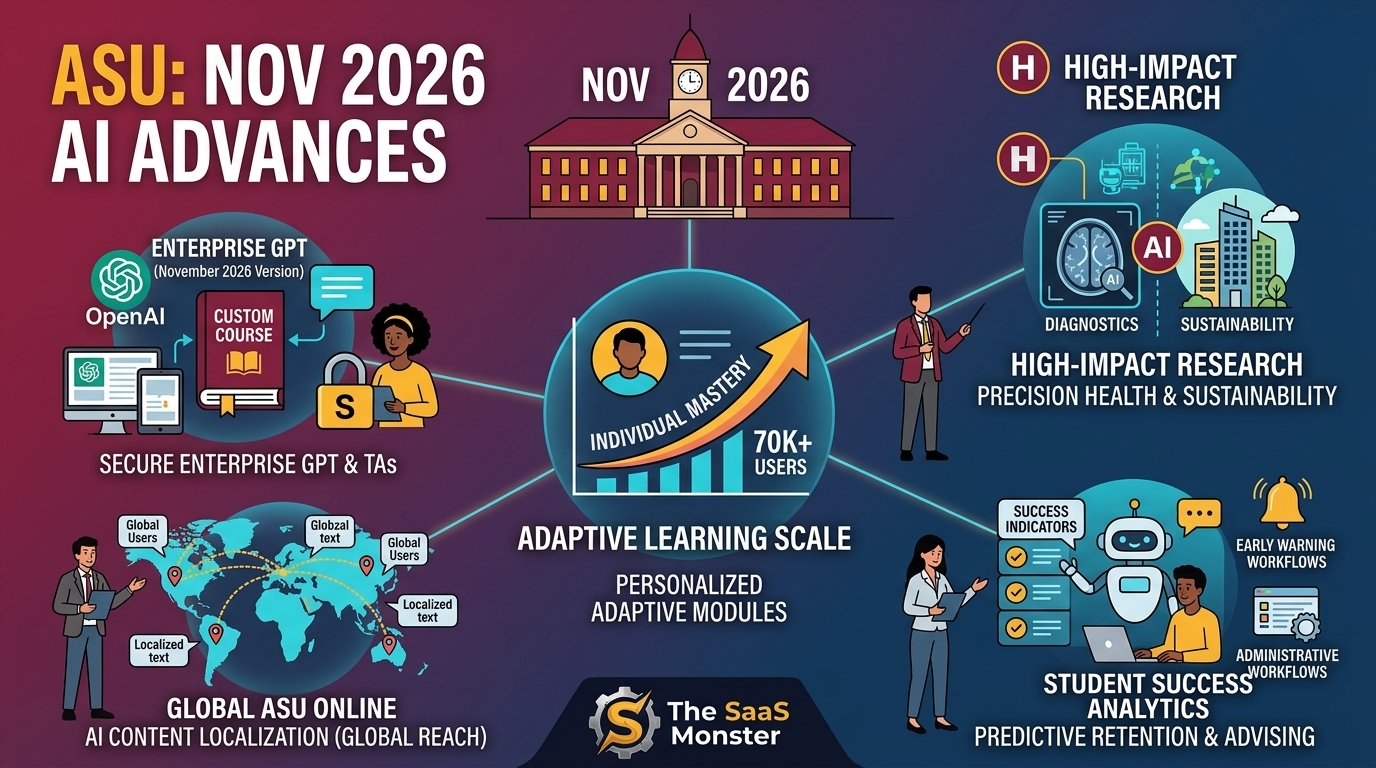
Arizona State University (ASU), based in Tempe, Arizona, continues to lead higher education into the artificial intelligence era. As of November 2026, ASU has scaled its enterprise-wide AI initiatives to new heights, establishing modern benchmarks for student success, adaptive learning, and multi-disciplinary research.
For SaaS founders, academic leaders, and tech enthusiasts tracking digital transformation, ASU’s ongoing integration of generative tools and machine learning offers a powerful blueprint for scalable education. Here is how Arizona State University is advancing AI across its ecosystem in late 2026.
1. Enterprise AI Ecosystem & GPT Integration
Building upon its historic collaboration with OpenAI, ASU has expanded its secure, internal AI environment for thousands of students, faculty, and administrative staff.
-
Custom Course GPTs: Professors deploy specialized AI assistants trained exclusively on validated course materials, offering students 24/7 interactive tutoring and immediate project guidance.
-
Strict Privacy Protocols: Institutional data, student assignments, and proprietary research remain protected within sandboxed environments, ensuring sensitive data is never used to train public commercial models.
-
Faculty Empowerment: Departmental workshops enable instructors across all disciplines—from humanities to engineering—to design interactive rubrics and automated learning scenarios seamlessly.
2. Adaptive Learning Engines at Scale
With a massive student population spanning physical campuses and online programs, delivering personalized attention requires scalable technology. ASU leverages machine learning engines to tailor academic paths to individual learning styles.
-
Dynamic Math & Science Modules: AI-driven adaptive platforms continually assess student comprehension, automatically adjusting problem difficulty and providing remedial practice for complex topics.
-
Virtual Academic Tutors: Automated AI agents handle routine course inquiries, freeing up teaching assistants and faculty to conduct targeted, high-impact mentoring sessions.
3. High-Impact Research at the Fulton Schools & CIC
At the Ira A. Fulton Schools of Engineering and the ASU Cloud Innovation Center (CIC), research teams deploy advanced artificial intelligence to solve complex real-world challenges.
-
Precision Health & Bio-Analytics: Researchers utilize deep learning models to process large-scale clinical datasets, accelerating early disease detection and personalized therapeutic strategies.
-
Desert Sustainability & Smart Infrastructure: Situated in the Sonoran Desert, ASU utilizes predictive AI algorithms to monitor urban microclimates, optimize municipal water consumption, and manage campus energy loads efficiently.
4. Expanding Global Reach via ASU Online
ASU Online utilizes intelligent automation to ensure high-quality educational access for non-traditional and international learners worldwide.
-
Automated Content Localization: Neural translation networks allow lecture recordings, reading materials, and assessment modules to be translated accurately into multiple languages in real time.
-
Frictionless Remote Proctoring: Machine vision tools assist in maintaining high standards of academic integrity while preserving a smooth, non-intrusive testing experience for remote students.
5. Predictive Student Analytics & Retention
Beyond the classroom, ASU applies natural language processing and predictive analytics to support university management and drive higher retention rates.
-
Early-Warning Support Systems: Algorithmic models analyze attendance patterns, assignment submissions, and portal engagement to spot at-risk students early, alerting advisors for timely intervention.
-
Automated Student Services: AI-powered conversational bots handle administrative workflows—such as financial aid queries, registration updates, and campus housing requests—minimizing queue times.
6. Comprehensive Ethics & Career Preparedness
ASU ensures that every graduate enters the modern workforce with strong AI literacy and a firm commitment to ethical standards.
-
Interdisciplinary Ethics Frameworks: Specialized courses cover algorithmic fairness, data privacy, intellectual property, and the societal implications of autonomous systems.
-
Practical Workforce Skills: Students work directly with AI tools in project-based settings, gaining practical experience in prompt engineering, automated data synthesis, and collaborative problem-solving.
The SaaS Monster Verdict
Arizona State University demonstrates how large public institutions can harness artificial intelligence to enhance educational quality at scale. By combining secure enterprise partnerships, personalized adaptive learning, and proactive student retention analytics, ASU’s Tempe campus continues to define the future of higher education in November 2026.