
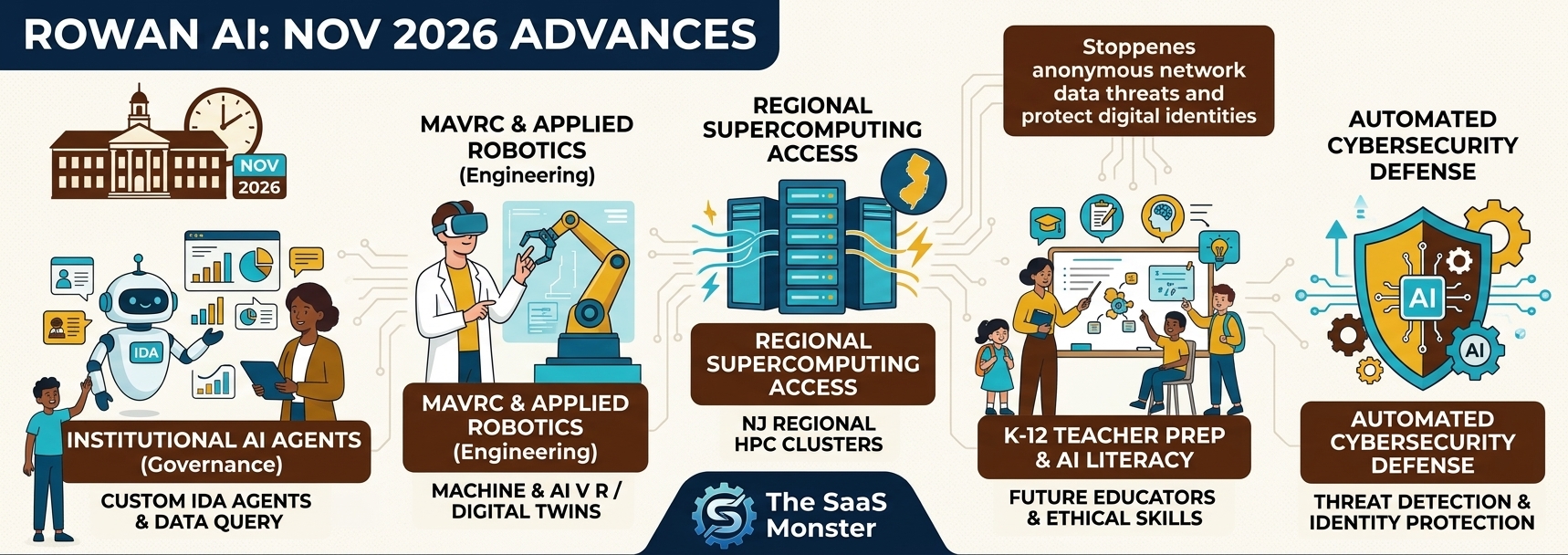
Rowan University, located in Glassboro, New Jersey, continues to build momentum as a national model for practical, high-impact artificial intelligence integration. As of November 2026, Rowan has significantly expanded its campus-wide AI capabilities, transforming how the mid-sized doctoral research institution handles administrative governance, interdisciplinary research, and modern classroom pedagogy.
For tech leaders, academic administrators, and SaaS enthusiasts, Rowan’s tailored approach proves that cutting-edge AI adoption does not require massive multi-billion-dollar enterprise budgets—it requires targeted execution. Here is how Rowan University is advancing artificial intelligence across its campus ecosystem in late 2026.
1. Institutional AI Agents & Autonomous Governance
Rowan’s Division of Academic Affairs and Institutional Data & Analytics (IDA) team have pushed internal administrative efficiency to new levels using specialized, domain-specific AI agents.
-
Custom IDA Query Agents: Administrators and department heads deploy autonomous AI agents capable of querying complex university data repositories in plain natural language, instantly retrieving real-time metrics on enrollment, graduation, and credit completion.
-
Predictive Yield & Financial Aid Analytics: Machine learning models analyze historical applicant trends to optimize financial aid allocation, predict incoming class size, and boost long-term retention rates across diverse undergraduate programs.
2. Cutting-Edge Research at MAVRC & Applied Robotics
At the Henry M. Rowan College of Engineering, researchers are developing real-world, industry-ready artificial intelligence applications.
-
Machine & AI Virtual Reality Center (MAVRC): Rowan’s state-of-the-art MAVRC facility merges spatial computing with neural networks, enabling complex digital twin simulations for manufacturing, architecture, and defense engineering partners.
-
Biomedical Sensors & Motion Analysis: Interdisciplinary teams pair lightweight wearable sensors with deep learning algorithms to track human biometric data, predicting injury risks for athletes and improving physical rehab protocols for elderly patients.
3. Collaborative High-Performance Supercomputing
Rowan continues to capitalize on regional computing partnerships, providing its faculty and graduate students with high-density processing power.
-
Shared Supercomputing Infrastructure: Through New Jersey’s collaborative AI research networks, Rowan accesses scalable GPU clusters that accelerate deep learning model training without burdening the university with excessive infrastructure costs.
-
Environmental & Security Modeling: Researchers utilize high-performance computing power to run predictive climate simulations, urban flood risk analysis, and advanced cybersecurity threat modeling in real time.
4. Classroom Pedagogy & Teacher Education Initiatives
Rowan is actively reshaping how future educators and current university students interact with artificial intelligence, moving beyond passive text prompts toward integrated workflow tools.
-
K-12 Educator Preparation: Researchers at the College of Education explore how generative AI tools can assist pre-service teachers in designing personalized lesson plans, assessing student cognitive progress, and supporting neurodivergent learners.
-
Agentic AI Learning Communities: University library groups and faculty working groups host hands-on workshops centered on “Agentic AI”—teaching students how to construct autonomous, multi-step digital workflows for academic research.
5. Automated Cybersecurity & Digital Identity Defense
As educational technology environments become increasingly interconnected, Rowan’s Center for Cybersecurity Education & Research prioritizes proactive, AI-assisted security.
-
Anomalous Threat Detection: Machine learning networks continuously scan campus digital infrastructure, spotting subtle anomalies and preventing unauthorized access before vulnerabilities can be exploited.
-
Digital Credentials Protection: Computer science researchers design next-generation authentication models to protect student records, financial aid portals, and intellectual property from automated cyber threats.
6. Enterprise Privacy & Practical AI Literacy
To ensure long-term sustainability, Rowan enforces strict privacy frameworks and university-wide digital literacy initiatives.
-
Data Privacy Guardrails: Rowan’s cloud policies mandate that all internal academic data, institutional research, and student communications remain strictly sandboxed and excluded from training public commercial models.
-
Career-Ready Skill Development: Practical AI usage is embedded across non-technical majors—including business, journalism, and humanities—ensuring graduates possess relevant skills in prompt engineering and human-AI collaboration.
The SaaS Monster Verdict
Rowan University demonstrates that practical, focused innovation can rival larger institutional initiatives. By combining custom administrative agents with hands-on engineering research and collaborative supercomputing access, Rowan’s Glassboro campus sets a premier benchmark for higher education in November 2026.