
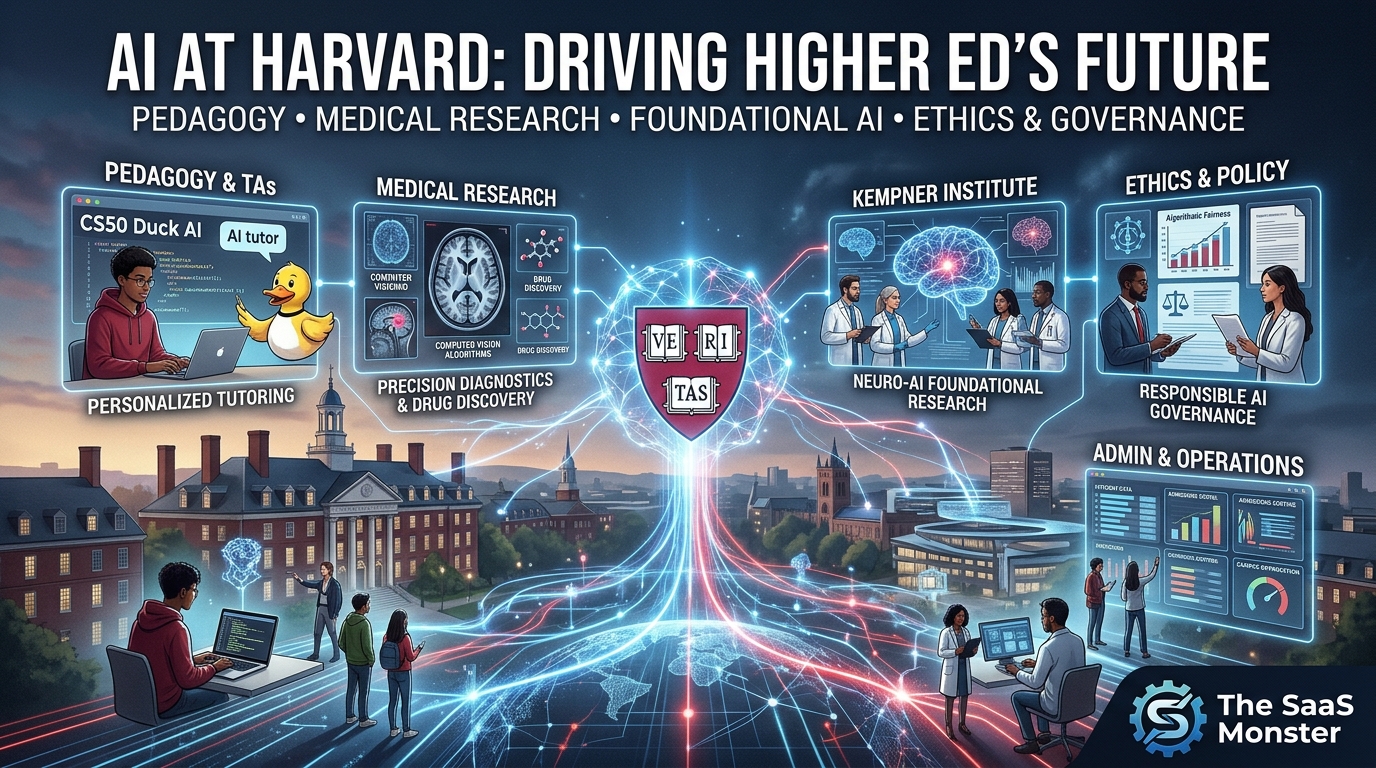
Harvard University, one of the world’s premier academic institutions, is actively integrating artificial intelligence into its research labs, medical facilities, administrative offices, and undergraduate classrooms. Far from restricting generative tools, Harvard is taking a leading role in establishing best practices for AI-driven higher education, multi-disciplinary research, and ethical governance.
For tech leaders, academic administrators, and SaaS enthusiasts, observing how top-tier universities navigate the AI shift offers a roadmap for the future of education. Here is how Harvard University leverages artificial intelligence across its core operations.
1. Classroom Pedagogy & AI Teaching Assistants
Harvard is reimagining the learning experience by embedding customized AI tools into its core curriculum. Rather than banning generative tools, professors encourage structured AI usage to foster critical thinking and problem-solving skills.
-
The CS50 Duck (AI Tutor): Harvard’s flagship introductory computer science course, CS50, developed its own proprietary AI tool called the “CS50 Duck.” This automated assistant guides students through code debugging by providing hints and conceptual explanations rather than simply outputting direct answers.
-
Personalized Learning at Scale: AI tutors allow students to receive immediate, personalized feedback on assignments at any time of day, bridging the gap between student inquiries and office hours.
2. Cutting-Edge Scientific & Medical Research
At the Harvard John A. Paulson School of Engineering and Applied Sciences (SEAS) and Harvard Medical School (HMS), AI is accelerating scientific discoveries at an unprecedented rate.
-
Genomic Analysis & Drug Discovery: Researchers deploy deep learning algorithms to analyze massive genomic datasets, predicting protein folding structures and discovering potential drug compounds in months rather than decades.
-
Precision Diagnostics: Harvard-affiliated hospitals utilize computer vision algorithms to detect early-stage cancers, analyze complex MRI scans, and predict patient outcomes with high diagnostic precision.
3. The Kempner Institute & Fundamental AI Research
Harvard’s commitment to advancing foundational AI technology is exemplified by the Kempner Institute for the Study of Natural and Artificial Intelligence.
-
Neuro-AI Intersections: The institute brings together neuroscientists, computer scientists, and cognitive researchers to understand how the human brain processes information and apply those findings to construct next-generation neural networks.
-
Scalable Computing Power: Equipped with high-performance computing clusters, Harvard researchers analyze complex intelligence frameworks to create more efficient, robust, and transparent AI models.
4. Policy, Ethics, and Governance Frameworks
As AI capabilities expand, so do the risks related to algorithmic bias, privacy, and societal impact. Harvard leads global conversations on responsible AI development through dedicated academic centers.
-
The Berkman Klein Center for Internet & Society: Scholars at Berkman Klein conduct extensive research on algorithmic fairness, intellectual property rights in generative AI, and regulatory frameworks for national and global governance.
-
Interdisciplinary Ethics Guidelines: Harvard faculties collaborate across law, philosophy, and technology to establish clear ethical standards for automated decision-making systems in healthcare, finance, and criminal justice.
5. Administrative Efficiency & Campus Operations
Beyond research and teaching, Harvard relies on AI-powered infrastructure to optimize university management and administrative workflows.
-
Admissions & Data Management: AI tools assist administrative teams in processing thousands of applicant inquiries, managing donor records, and optimizing financial aid allocations.
-
Campus Sustainability & Facilities: Machine learning models optimize HVAC systems, predict energy demands across campus buildings, and manage historical archives efficiently.
6. Enterprise AI Access & Internal Guidelines
To protect institutional intellectual property and student privacy, Harvard introduced secure internal guidelines and sandboxed AI tools for faculty, staff, and students.
-
Data Privacy Protection: Harvard provides clear compliance tiers ensuring that sensitive academic, medical, and institutional data is not used to train public commercial AI models.
-
AI Literacy Initiatives: The university offers workshops, online courses through Harvard Online, and university-wide symposiums to ensure all community members develop robust AI literacy skills.
The SaaS Monster Verdict
Harvard University demonstrates that artificial intelligence, when implemented with clear ethical boundaries, does not diminish academic rigor—it elevates it. By blending advanced AI tutoring with groundbreaking medical research and policy governance, Harvard sets the gold standard for how higher education can harness technological disruption to shape the leaders of tomorrow.