
Arizona State University (ASU), located in Tempe, Arizona, has long been recognized as a trailblazer in higher education innovation. True to its reputation as one of the most innovative universities in the United States, ASU is actively embedding artificial intelligence into its academic programs, research initiatives, and administrative infrastructure.
Instead of treating AI tools as a disruption, ASU embraces them as scaling mechanisms to expand educational access, personalize instruction, and accelerate cross-disciplinary research. For SaaS leaders, tech enthusiasts, and academic administrators, ASU’s forward-thinking approach offers a vital blueprint for the digital transformation of higher education. Here is how Arizona State University is leveraging AI across its campus ecosystem.
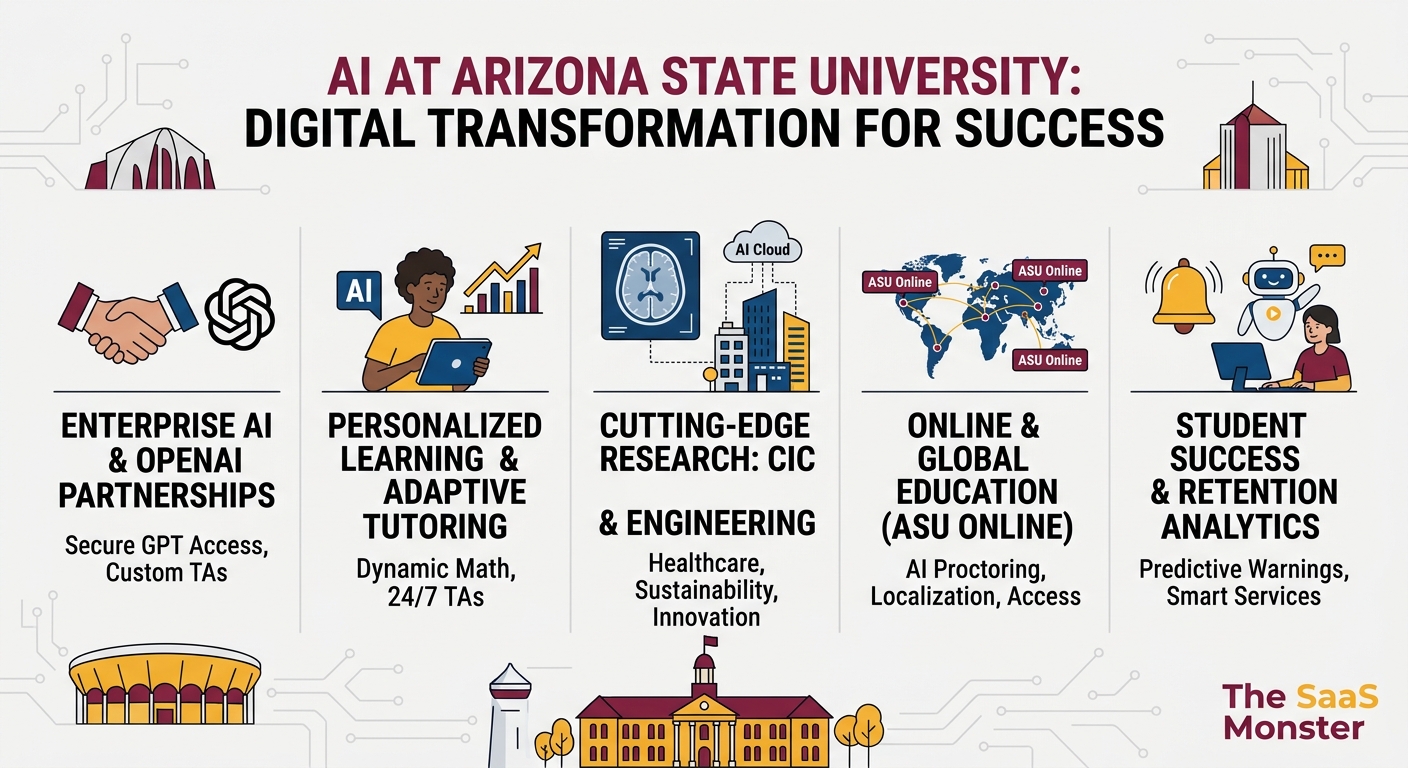
1. Enterprise AI Partnerships & OpenAI Collaboration
ASU made history by becoming the first higher education institution to partner directly with OpenAI. This groundbreaking collaboration provides students, faculty, and researchers with enterprise-level access to advanced ChatGPT capabilities in a secure environment.
-
Custom Academic GPTs: Faculty members build tailored ChatGPT versions designed specifically for their courses, offering students continuous, interactive feedback aligned directly with class syllabi.
-
Data Security & Privacy: Through enterprise privacy protocols, institutional data and student work remain fully protected and are excluded from training public commercial models.
-
Widespread Adoption: From engineering to the humanities, instructors across campus utilize AI to generate interactive study modules, construct dynamic assignment rubrics, and simulate real-world scenarios.
2. Personalized Learning & Adaptive Coursework
At a large public university serving tens of thousands of students on campus and online, delivering individual attention can be challenging. ASU solves this scalability issue by deploying adaptive, AI-driven learning tools.
-
Adaptive Math & Science Curricula: Platforms powered by machine learning assess each student’s baseline knowledge, adjusting problem sets dynamically based on mastery speed. Struggling students receive targeted remedial practice, while advanced students move ahead seamlessly.
-
24/7 Virtual Teaching Assistants: Automated AI tutors handle repetitive queries regarding assignment guidelines, deadlines, and foundational course concepts, allowing professors and teaching assistants to focus on high-impact mentoring.
3. Cutting-Edge Research at the AI Cloud Innovation Center
In partnership with major technology providers, the ASU Cloud Innovation Center (CIC) and the Ira A. Fulton Schools of Engineering lead ambitious research projects leveraging artificial intelligence, cloud computing, and big data.
-
Healthcare & Precision Medicine: Researchers develop AI algorithms to analyze complex medical imaging, predict patient outcomes, and model disease progression to accelerate clinical discoveries.
-
Smart Cities & Environmental Sustainability: Located in the Sonoran Desert, ASU utilizes machine learning models to monitor urban heat islands, optimize municipal water distribution, and project energy consumption patterns across the Tempe campus.
4. Revolutionizing Online & Global Education
ASU Online is a global powerhouse, and AI plays a central role in delivering high-quality remote education to non-traditional and international learners.
-
AI-Enhanced Proctoring & Integrity: Advanced vision and sound algorithms help maintain academic integrity during remote assessments while providing a frictionless testing environment.
-
Automated Content Localization: Machine learning translation tools enable ASU to expand its global course reach, translating instructional materials, transcripts, and lectures into multiple languages instantly.
5. Administrative Efficiency & Student Success Analytics
Beyond classroom instruction, ASU relies on predictive analytics and natural language processing to streamline campus management and improve retention rates.
-
Early-Warning Retention Systems: AI algorithms analyze attendance trends, learning management system engagement, and midterm performance to identify at-risk students long before final grades are posted. Academic advisors receive automated alerts to schedule timely interventions.
-
Smart Student Services: AI-powered chatbots handle routine administrative tasks—such as financial aid inquiries, campus housing requests, and course registration updates—reducing wait times significantly.
6. Teaching AI Ethics, Literacy & Future-Proofing Careers
ASU recognizes that preparing students for the modern workforce requires comprehensive AI literacy and a strong ethical foundation.
-
Interdisciplinary Ethics Courses: Students explore algorithmic bias, privacy rights, intellectual property, and the societal impact of automation across business, law, and journalism.
-
Future-Ready Skills: By integrating AI tools directly into project work, ASU ensures graduates enter the job market with hands-on experience in prompt engineering, automated data analysis, and human-AI collaboration.
The SaaS Monster Verdict
Arizona State University proves that incorporating artificial intelligence at a massive public university does not compromise educational quality—it elevates it. By pairing strategic industry partnerships with personalized learning engines and proactive student support systems, ASU’s Tempe campus continues to set the benchmark for the future of higher education in the AI era.