
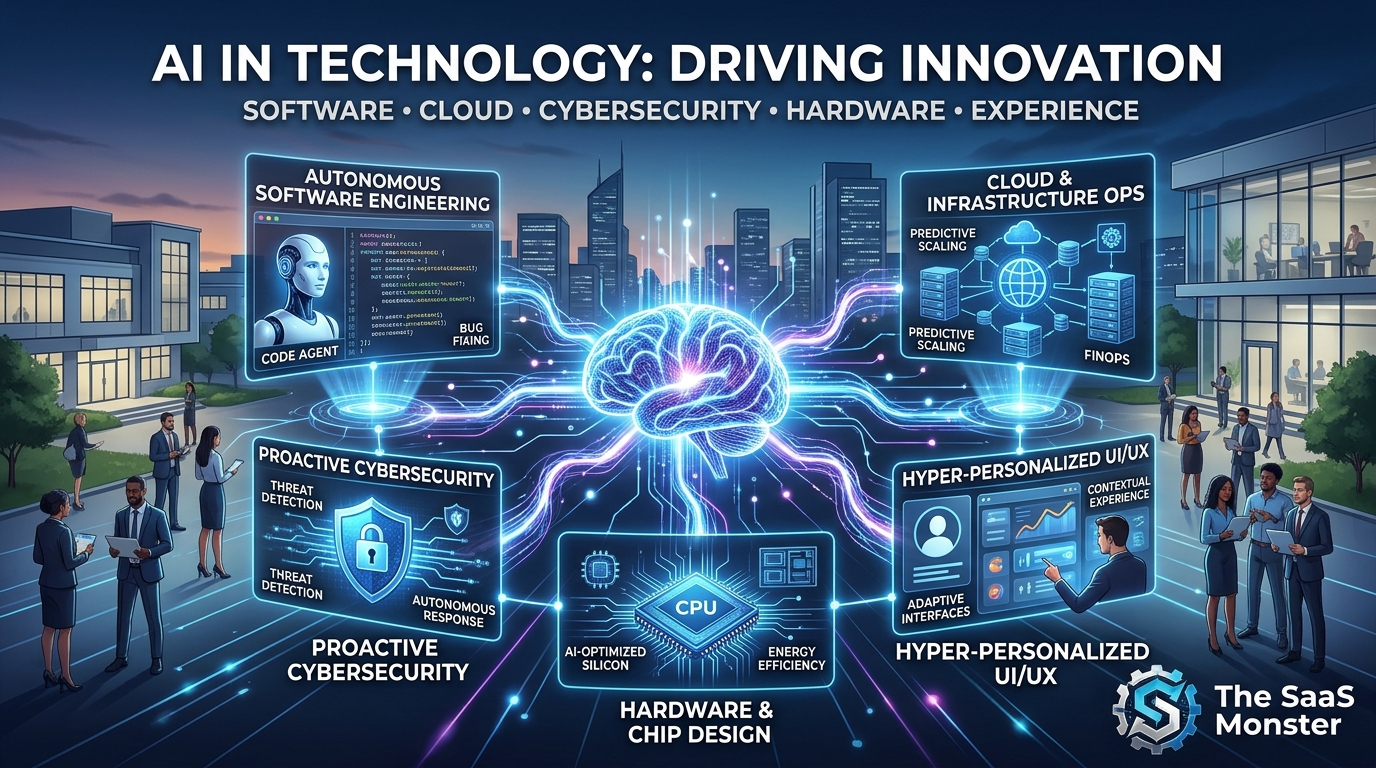
Artificial Intelligence is no longer just a feature embedded within software; it has become the core foundation of the entire technology sector. In 2026, AI technologies are reshaping every tier of the digital landscape—from low-level silicon microchip design to high-level cloud architecture and multi-tier cybersecurity defense systems.
For software developers, SaaS founders, and enterprise technology leaders, understanding this profound transformation is crucial. Here is a comprehensive look at how artificial intelligence is actively powering and revolutionizing the modern tech industry.
1. Autonomous Software Engineering & Code Generation
Software development has undergone its most dramatic evolution since the advent of high-level programming languages. Developers no longer rely solely on manual coding line by line; instead, they collaborate with autonomous AI coding agents to architect, test, and deploy applications.
-
Instant Code Completion & Refactoring: Advanced AI models generate production-ready code snippets, complete full-stack web applications, and optimize legacy codebases within seconds.
-
Automated Bug Detection & Patching: Modern AI security tools continuously scan code repositories in real time, identifying logic errors, syntax mistakes, and security vulnerabilities before code is pushed to production.
-
Legacy Codebase Modernization: Converting outdated programming languages (such as legacy Java or COBOL) into modern frameworks has become up to ten times faster with AI translation models.
2. Next-Generation Cloud Infrastructure & Operations
Managing enterprise cloud computing environments without AI has become virtually impossible. Modern cloud providers leverage AI-native intelligence to optimize server health, bandwidth allocation, and infrastructure overhead.
-
Predictive Resource Scaling: Machine learning algorithms forecast traffic spikes and automatically scale server capacity up or down, ensuring zero downtime while avoiding server over-provisioning.
-
Intelligent FinOps: AI-driven cloud financial management continuously scans active workloads, identifying unused instances and optimizing computing costs to save enterprises millions annually.
3. Proactive Cybersecurity & Autonomous Threat Response
With the expanding digital attack surface, traditional perimeter defenses are insufficient. AI systems act as continuous automated guardians across global networks.
-
Real-Time Threat Detection: AI algorithms analyze billions of data packets across complex corporate networks to detect subtle anomalies and zero-day threats in milliseconds.
-
Instant Incident Mitigation: When a breach or malware infection occurs, autonomous AI agents isolate affected microservices and apply emergency security patches instantly without human latency.
4. Hardware Architecture & Semiconductor Design
AI is not only driving software innovation—it is also transforming the physical silicon chips that compute modern workloads.
-
AI-Designed Microchips: Leading technology companies use machine learning algorithms to optimize transistor placements, routing paths, and microchip architecture layouts.
-
Energy-Efficient Computing: AI-optimized chip configurations maximize processing output while drastically reducing power consumption, enabling sustainable next-generation computing hardware.
5. Hyper-Personalized User Experience & Adaptive Interfaces
Digital products and SaaS applications are shifting from static, rigid layouts to dynamic, self-adapting user interfaces.
-
Contextual User Interfaces: AI monitors user interaction patterns to automatically adjust dashboards, toolbars, and feature recommendations based on individual workflows.
-
Natural Language Control: Users no longer need to navigate deep settings menus; instead, complex actions, database queries, and custom configurations can be executed using simple natural language prompts.
6. AI-Driven DevOps & Continuous Deployment
Deployment pipelines have achieved unprecedented reliability through automated integration and continuous delivery (CI/CD) pipelines powered by machine learning.
-
Automated Testing Suites: AI generates comprehensive unit and integration tests based on user flows, ensuring exhaustive code coverage without manual script writing.
-
Predictive Deployment Risk: Machine learning models evaluate recent code commits against historic deployment data to assign risk scores, preventing unstable code releases.
The SaaS Monster Verdict
Artificial intelligence is no longer an optional add-on in the tech industry—it is the default operating engine for innovation. Organizations, developers, and tech leaders who embrace AI-native workflows are scaling ten times faster, driving unmatched technical performance and setting the standard for the future of digital software.