
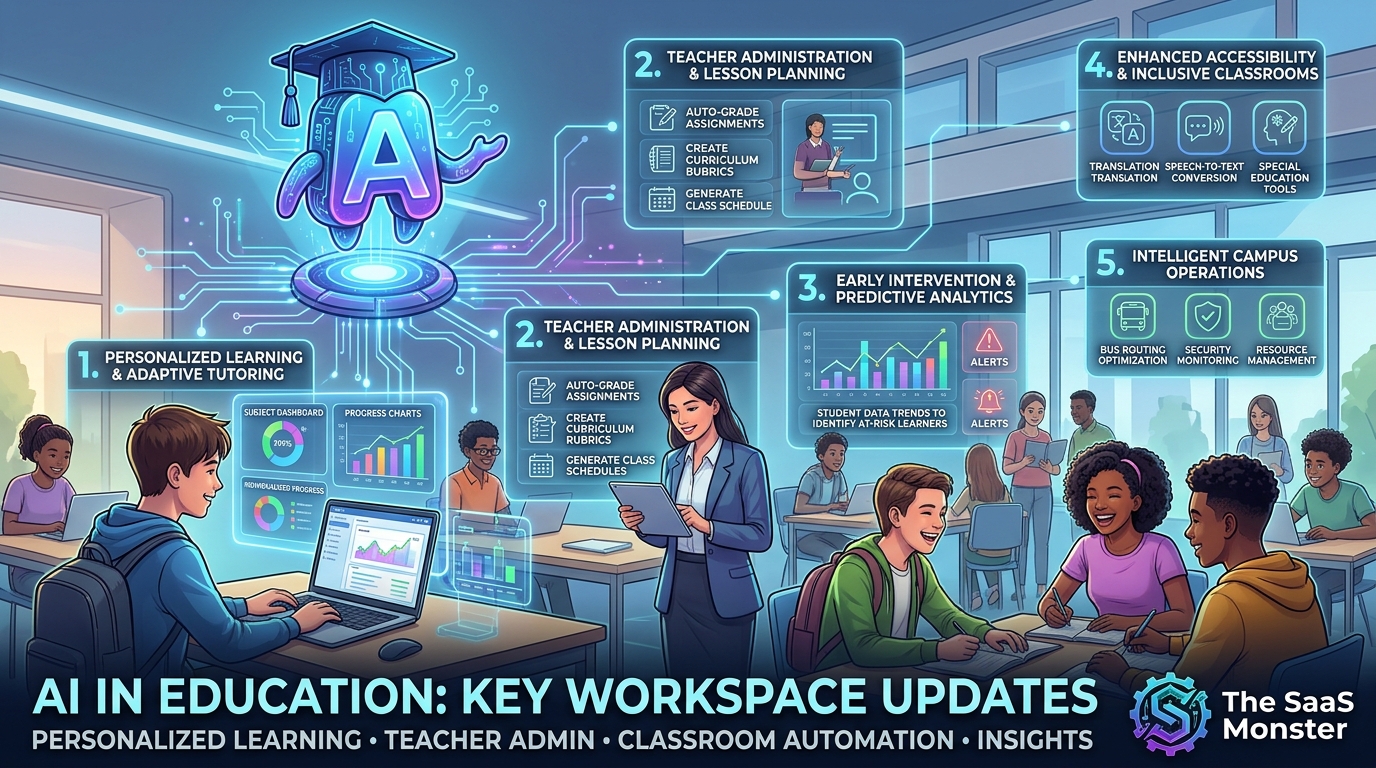
Artificial Intelligence is fundamentally restructuring modern education. Once viewed with skepticism, AI tools are now actively integrated into K-12 classrooms and university campuses to personalize learning, reduce administrative burdens on teachers, and improve student outcomes.
For educational leaders, tech enthusiasts, and SaaS innovators, understanding this transition is key. Here is a comprehensive look at how schools are utilizing AI in 2026.
1. Personalized Learning & Adaptive Tutoring
Traditional classroom models often struggle to accommodate students operating at different learning speeds. AI-powered adaptive platforms solve this issue by customizing educational content in real time.
-
Targeted Skill Building: Intelligent systems evaluate individual student performance, identifying specific gaps in comprehension across subjects like mathematics, reading, and science.
-
Customized Pacing: Students receive personalized exercise sets that automatically adjust difficulty levels, ensuring struggling students get foundational support while advanced learners remain engaged.
2. Automating Teacher Administration
Teachers frequently spend dozens of hours every week handling administrative overhead rather than direct instruction. AI automation tools are significantly reducing this workload.
-
Automated Grading: Advanced algorithms can now evaluate multiple-choice assessments, mathematical proofs, and short-form written answers, returning instant feedback to students.
-
Curriculum Design & Lesson Planning: AI co-pilots assist teachers in drafting lesson plans, creating custom rubrics, generating quiz questions, and formatting differentiated materials for diverse classroom needs in a fraction of the time.
3. Early Intervention & Predictive Analytics
Dropout rates and academic failure often result from late detection. Educational institutions are deploying predictive AI analytics to identify at-risk students long before final exams.
-
Behavioral & Academic Monitoring: By analyzing attendance patterns, quiz trends, and LMS (Learning Management System) activity, AI systems alert counselors when a student displays signs of academic decline.
-
Tailored Support Strategies: School administration teams receive data-backed recommendations on early interventions, enabling targeted tutoring sessions or mental health check-ins.
4. Enhanced Accessibility & Inclusive Classrooms
AI technology is breaking down traditional learning barriers for neurodivergent students and non-native language speakers.
-
Real-Time Translation & Transcription: Multilingual AI tools provide live speech-to-text translation during lectures, allowing English language learners to follow along effortlessly.
-
Assistive Tools for Special Education: Text-to-speech generators, screen readers, and speech-to-text input tools empower students with visual, auditory, or motor impairments to participate fully in standard curricula.
5. Intelligent Campus Operations
Beyond the classroom, school districts and university campuses leverage AI infrastructure to streamline operations and enhance physical safety.
-
Resource & Facility Scheduling: Machine learning algorithms optimize bus routing, cafeteria inventory management, and energy consumption across campus facilities.
-
Security & Crisis Prevention: AI-enhanced monitoring systems process network traffic to detect cybersecurity threats and assist campus security with emergency response protocols.
6. Teaching AI Literacy & Ethics
As AI becomes ubiquitous across industries, schools are shifting from simply using AI to actively teaching it.
-
Prompt Engineering & Critical Thinking: Curricula now include modules on how to write effective prompts, verify AI output for factual hallucinations, and apply critical thinking to automated results.
-
Academic Integrity Protocols: Schools are updating honor codes to emphasize ethical AI usage, guiding students on how to treat AI as a research partner rather than a shortcut for original work.
The SaaS Monster Verdict
AI integration in schools is no longer an experiment; it is the modern standard for effective education. By automating routine administrative tasks and delivering personalized instruction, AI empowers educators to focus on what matters most: mentoring, inspiring, and connecting with their students.