
MagicLight AI has an ambitious proposition: turn an idea, script, or story into a complete video while maintaining consistent characters and connected scenes across projects advertised at up to 50 minutes long. Its current platform brings together story-to-video generation, scripts, AI characters, voice cloning, subtitles, animation, and editing in one workflow.
That makes MagicLight particularly interesting for:
- Long-form story videos
- Faceless YouTube channels
- Children’s stories
- Historical narratives
- Religious and spiritual storytelling
- Educational explainers
- Animated content
But MagicLight is not automatically the best AI video tool for every creator.
You may need more natural AI voices. You might prefer realistic avatars. Your goal could be corporate training rather than storytelling. Perhaps you already have blog posts, PowerPoint presentations, or podcasts that you want to turn into videos. Or you may need greater control over cinematic visuals and individual scenes.
That is where MagicLight AI alternatives become relevant.
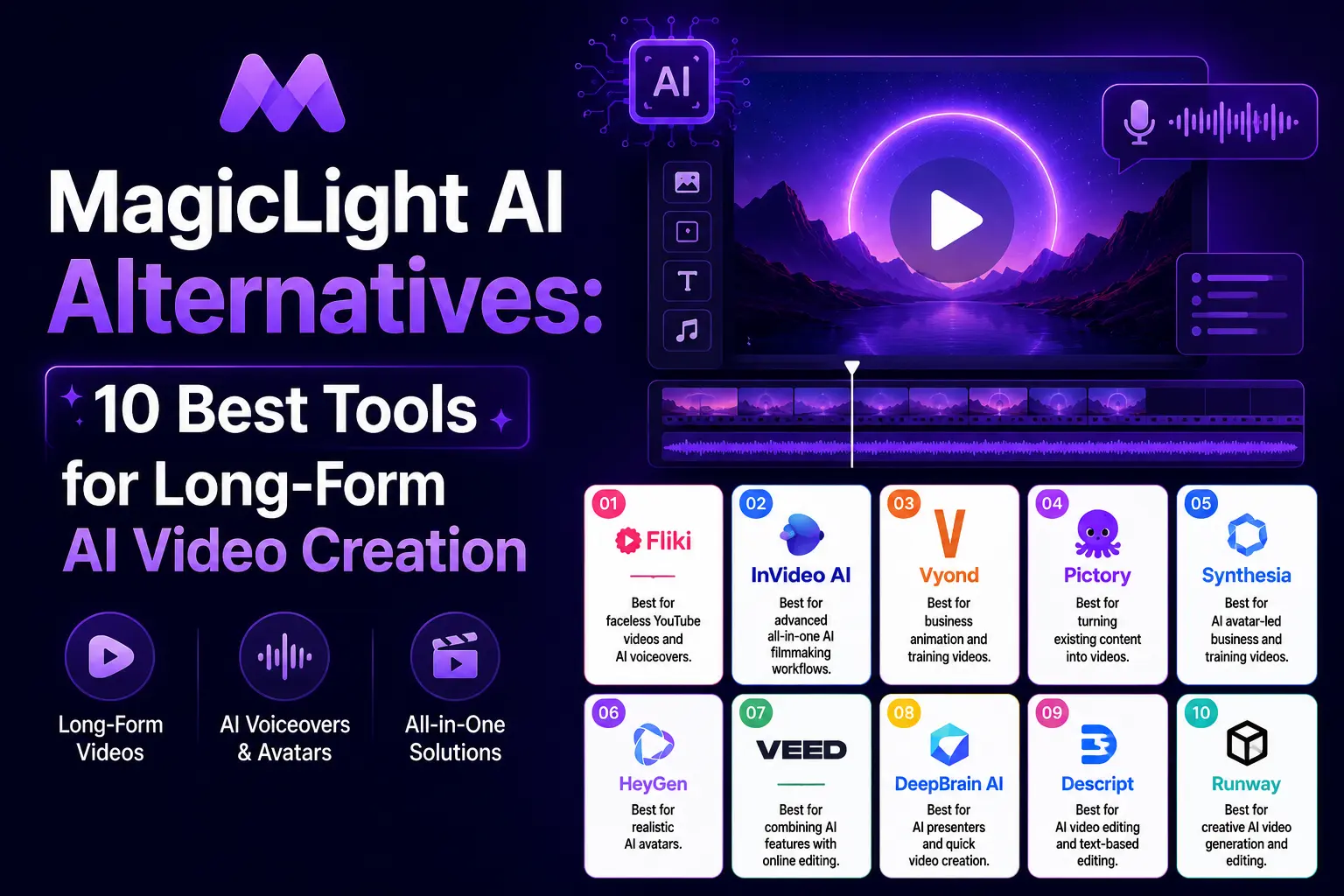
After examining the current capabilities of leading AI video platforms, these are the 10 alternatives I would consider first:
- Fliki — Best for faceless YouTube videos and AI voiceovers.
- InVideo AI — Best for advanced all-in-one AI filmmaking workflows.
- Vyond — Best for business animation and training videos.
- Pictory — Best for turning existing content into videos.
- Synthesia — Best for AI avatar-led business and training videos.
- HeyGen — Best for realistic AI avatars.
- VEED — Best for combining AI generation with practical video editing.
- Runway — Best for cinematic AI-generated footage.
- Colossyan — Best for employee training and e-learning.
- Steve AI — Best for animated explainers and story-based videos.
Quick verdict: Fliki is the strongest MagicLight alternative for faceless YouTube creators who prioritize voiceovers and script-to-video workflows. InVideo AI is more compelling for advanced creative workflows involving storyboarding, AI models, agents, and timeline editing. Vyond is better for controlled business animation, while Pictory is stronger when you already have articles, scripts, presentations, podcasts, or existing videos to repurpose. MagicLight remains particularly differentiated by its direct emphasis on coherent, multi-scene, long-form story generation.
On this Content
- 0.1. Affiliate Disclosure
- 0.2. How We Selected These MagicLight AI Alternatives
- 0.3. MagicLight AI Alternatives at a Glance
- 0.4. What Should You Look for in a MagicLight Alternative?
- 1. 1. Fliki — Best MagicLight Alternative for Faceless YouTube Videos
- 2. 2. InVideo AI — Best for Advanced AI Filmmaking Workflows
- 3. 3. Vyond — Best for Business Animation and Training Videos
- 4. 4. Pictory — Best for Turning Existing Content Into Videos
- 5. 5. Synthesia — Best for AI Avatar Training and Business Videos
- 6. 6. HeyGen — Best for Realistic AI Avatars
- 7. 7. VEED — Best for Combining AI Video Generation and Editing
- 8. 8. Runway — Best for Cinematic AI-Generated Visuals
- 9. 9. Colossyan — Best for Training and E-Learning
- 10. 10. Steve AI — Best for Animated Explainers and Story-Based Videos
- 11. Which MagicLight AI Alternative Is Best for You?
- 11.1. Best for faceless YouTube: Fliki
- 11.2. Best for advanced AI filmmaking: InVideo AI
- 11.3. Best for business animation: Vyond
- 11.4. Best for repurposing existing content: Pictory
- 11.5. Best for avatar-led training: Synthesia
- 11.6. Best for realistic avatars: HeyGen
- 11.7. Best for AI creation plus editing: VEED
- 11.8. Best for cinematic clips: Runway
- 11.9. Best for employee training: Colossyan
- 11.10. Best for animated explainers: Steve AI
- 12. MagicLight vs Fliki: Which Is Better?
- 13. MagicLight vs InVideo AI: Which Is Better?
- 14. MagicLight vs Vyond: Which Is Better?
- 15. MagicLight vs Pictory: Which Is Better?
- 16. Is MagicLight Still the Best for Long-Form Storytelling?
- 17. Our Final Verdict
- 17.1. Frequently Asked Questions
- 17.1.1. What is the best MagicLight AI alternative?
- 17.1.2. Is Fliki better than MagicLight AI?
- 17.1.3. Is InVideo AI better than MagicLight?
- 17.1.4. What is the best MagicLight alternative for YouTube?
- 17.1.5. What is the best alternative for long-form AI videos?
- 17.1.6. Which MagicLight alternative is best for business videos?
- 17.1.7. Which alternative is best for turning a blog into a video?
- 17.1.8. Which MagicLight alternative has the best AI voices?
- 17.1.9. Which tool is best for AI avatars?
- 17.1.10. Is Runway a direct MagicLight alternative?
- 17.2. Editor’s Update History
- 17.1. Frequently Asked Questions
Affiliate Disclosure
Some links in this article may be affiliate links. If you purchase through one of these links, TheSaaSMonster may earn a commission at no extra cost to you. This does not affect our editorial conclusions or the price you pay.
How We Selected These MagicLight AI Alternatives
This is a research-based comparison.
We reviewed the current public product pages and available feature information for MagicLight and the competing platforms included in this guide.
We considered:
- Long-form video capabilities
- Script-to-video workflows
- Storytelling support
- AI voice options
- Character or avatar consistency
- Editing control
- Visual generation
- Faceless YouTube suitability
- Educational use
- Business video capabilities
- Content repurposing
- Ease of creating multi-scene videos
The information was checked on July 10, 2026.
This article does not claim that every paid plan, feature, AI model, and workflow on all 10 platforms was personally tested through an extended subscription.
Our recommendations are therefore based on current product capabilities and use-case fit, not fabricated hands-on experience.
MagicLight AI Alternatives at a Glance
| Tool | Best for | Main advantage over MagicLight | Main trade-off |
| Fliki | Faceless YouTube and voiceovers | 2,000+ voices and 80+ languages | Less focused on 50-minute story continuity |
| InVideo AI | Advanced AI filmmaking | Agents, storyboarding, timeline and 200+ models | May be more complex |
| Vyond | Business animation | Controlled animation and enterprise use cases | Less focused on cinematic story generation |
| Pictory | Content repurposing | Converts blogs, URLs, PPTs, audio and scripts | More repurposing-focused |
| Synthesia | Training and presenter videos | AI avatars and 160+ languages | Less suited to animated narrative storytelling |
| HeyGen | Realistic avatar content | Lifelike customizable avatars | Not a direct story-animation replacement |
| VEED | AI generation plus editing | Multiple AI models and full editing workflow | Long-form storytelling is not its primary specialization |
| Runway | Cinematic AI visuals | High-end generative video quality | Better for individual clips than automated full stories |
| Colossyan | Corporate learning | Courses, assessments and interactive training | Not aimed at entertainment storytelling |
| Steve AI | Animation and explainers | Text-to-animation and story formats | Less specialized in very long narrative projects |
What Should You Look for in a MagicLight Alternative?
Before choosing another tool, identify exactly what you dislike or cannot accomplish with MagicLight.
Choose based on your real workflow
You may need:
A better faceless YouTube workflow
Look at Fliki or Pictory.
A more advanced AI filmmaking environment
Look at InVideo AI or Runway.
Business animation
Look at Vyond.
Presenter-led AI videos
Look at Synthesia, HeyGen, or Colossyan.
Traditional editing plus generative AI
Look at VEED.
Animated storytelling and explainers
Look at Steve AI.
The best alternative is not necessarily the platform with the longest feature list.
It is the one that removes the biggest bottleneck from your actual production process.
1. Fliki — Best MagicLight Alternative for Faceless YouTube Videos
Best for: Faceless YouTube channels, voice-heavy videos, educational content, blogs-to-video, multilingual videos
Fliki is my first recommendation for creators whose primary goal is turning scripts, ideas, blog posts, URLs, PowerPoint files, or PDFs into narrated videos.
The current platform supports:
- Scripts to video
- Ideas to video
- Blogs to video
- PPT and PDF input
- 2,000+ AI voices
- 80+ languages
- 100+ dialects
- Voice cloning
- AI avatars
- AI-generated and stock visuals
- Automatic subtitles
- Background music
- Multiple aspect ratios
- 1080p exports, with 4K available on some paid plans
Fliki explicitly positions its long-form YouTube workflow around videos from approximately 5 to 15 minutes, with AI narration, chaptered scenes, B-roll, and subtitles.
Where Fliki is stronger than MagicLight
The biggest differentiator is voice.
Fliki currently advertises more than 2,000 AI voices across 80+ languages, together with multilingual voice cloning. That makes it particularly attractive for creators producing:
- Documentary-style YouTube videos
- History channels
- Top-10 videos
- True-crime content
- Educational videos
- International content
- Voice-led faceless channels
Where MagicLight may be better
MagicLight places greater emphasis on:
- Character consistency
- Connected multi-scene storytelling
- Recurring characters
- Story templates
- Long-form projects advertised at up to 50 minutes
So the choice is relatively clear.
Choose Fliki when:
- Voice quality and selection matter enormously.
- You create 5-to-15-minute faceless YouTube videos.
- You want to convert blogs or documents into videos.
- You need multilingual output.
Choose MagicLight when:
- Your video revolves around recurring characters.
- You want longer story-driven projects.
- Maintaining narrative and visual continuity is the main challenge.
Our verdict: Fliki is probably the strongest MagicLight alternative for a traditional faceless YouTube workflow.
2. InVideo AI — Best for Advanced AI Filmmaking Workflows
Best for: AI filmmaking, storyboarding, multi-scene projects, ads, microdramas, creators wanting broader model access
InVideo has evolved into a much broader AI creative platform.
Its current platform includes:
- AI video generation
- AI movie making
- Storyboarding
- Script writing
- Timeline editing
- AI avatars
- Voice cloning
- Video translation
- Multiple collaborating AI agents
- Access to more than 200 image, video, audio, and music models on paid plans
The current product also advertises model access including technologies such as Veo, Sora, Kling, Seedance, and others.
One particularly interesting capability: persistent project context
InVideo says its agents can retain the full context of a project so clips remain consistent. Its current workflow allows creators to establish context, generate a storyboard, write scripts, edit on a timeline, and modify multiple shots.
That makes it a serious alternative for creators who need a broader filmmaking environment rather than a more narrowly story-focused generator.
Where InVideo AI is stronger than MagicLight
InVideo currently offers a particularly broad creative ecosystem involving:
- Multiple generative models
- Storyboarding
- Timeline editing
- Custom AI agents
- Collaborative workflows
- AI scriptwriting
- Microdrama production
- Shot-by-shot control
Where MagicLight may be better
MagicLight’s positioning is easier to understand for a specific use case:
Turn a story into a coherent long-form video with recurring characters and connected scenes.
A beginner who simply wants to make an animated story may find that narrower focus useful.
Choose InVideo AI when:
- You want advanced creative flexibility.
- You need access to many generation models.
- You want storyboarding plus timeline control.
- You create films, advertisements, or microdramas.
Choose MagicLight when:
- Your priority is a simpler long-form storytelling workflow.
- Recurring character consistency is central.
- You create children’s, religious, historical, or educational stories.
Our verdict: InVideo AI is the strongest alternative for creators who want a broader and potentially more advanced AI filmmaking system.
3. Vyond — Best for Business Animation and Training Videos
Best for: Corporate training, HR, education, internal communications, sales enablement, animated explainers
Vyond is a very different kind of MagicLight alternative.
Rather than focusing primarily on generative cinematic stories, Vyond combines AI-assisted video generation with controlled animation, customizable characters, assets, branding, and business-oriented workflows.
Its current platform includes:
- Vyond Go
- Vyond Studio
- Text-to-video
- AI avatars
- Human-avatar videos
- Instant AI video generation
- AI animation
- Custom assets
- Brand management
- Enterprise security features
Its main business use cases include training and e-learning, HR, internal communications, marketing, sales, and sales enablement.
Where Vyond is stronger than MagicLight
Vyond is better aligned with organizations that need:
- Controlled animated scenes
- Repeatable business characters
- Brand consistency
- Training videos
- Workplace communication
- Corporate explainers
It is less about asking AI to invent an entire cinematic narrative and more about creating controlled animated communication.
Where MagicLight may be better
MagicLight is more naturally suited to:
- Story-driven entertainment
- Kids’ videos
- Historical narratives
- Religious stories
- Long-form faceless storytelling
Choose Vyond when:
- You create business videos.
- You need training animations.
- You want controllable characters and corporate scenes.
- Your organization requires repeatability and branding.
Choose MagicLight when:
- You create narrative-driven content.
- Your video needs cinematic or illustrated story scenes.
- You want up to 50-minute long-form generation.
Our verdict: Vyond is the better choice for professional business animation; MagicLight is the stronger fit for automated story-based content.
4. Pictory — Best for Turning Existing Content Into Videos
Best for: Bloggers, podcasters, marketers, educators, content repurposing
Pictory is particularly compelling when you already have content.
Its current platform can turn the following into videos:
- Ideas
- URLs
- Images
- Scripts
- Documents
- PDFs
- PowerPoint presentations
- Audio recordings
- Screen recordings
- Blogs
- Existing videos
Pictory also combines AI-generated visuals, AI avatars, captions, voices, editing, highlight extraction, translation, and brand tools.
Where Pictory is stronger than MagicLight
Pictory is more flexible for content repurposing.
Imagine you already have:
- A 2,000-word blog post.
- A podcast episode.
- A webinar.
- A PowerPoint presentation.
- A long existing video.
- A training document.
Pictory is designed to help turn these existing assets into video content.
Where MagicLight may be better
MagicLight is more specialized in generating a story world from an idea or script with:
- Connected scenes
- Recurring characters
- Visual continuity
- Long-form narrative structure
Choose Pictory when:
- You already have lots of written content.
- You want blog-to-video workflows.
- You repurpose webinars and podcasts.
- You need highlights from existing long videos.
Choose MagicLight when:
- You are creating an original visual story.
- Recurring characters matter.
- Your focus is animation or narrative storytelling.
Our verdict: Pictory is the more practical alternative for businesses and creators with a large library of existing content.
5. Synthesia — Best for AI Avatar Training and Business Videos
Best for: Employee training, corporate communication, multilingual presenter videos, onboarding
Synthesia is not a direct replacement for MagicLight’s animated storytelling workflow.
It solves a different problem.
Its focus is creating professional videos using AI presenters rather than filming a human presenter repeatedly.
The current platform advertises:
- 240+ pre-built AI avatars
- Personal AI avatars
- Voiceovers in 160+ languages
- PowerPoint-to-video
- AI dubbing
- Professional video generation
- AI-generated B-roll through integrated models
Synthesia’s current free plan includes up to 10 minutes of video per month and access to AI avatars and voices in more than 160 languages.
Where Synthesia is stronger than MagicLight
Synthesia is more suitable for:
- Employee training
- Corporate onboarding
- Internal communications
- Product education
- Multilingual presenter content
Where MagicLight may be better
MagicLight is better suited to narrative content involving:
- Multiple scenes
- Characters
- Story development
- Animation
- Entertainment
Choose Synthesia when:
- You need a virtual presenter.
- You create corporate or training content.
- Localization is essential.
- You want to avoid filming a presenter repeatedly.
Choose MagicLight when:
- Your story itself is the main attraction.
- You need animated environments and recurring fictional characters.
Our verdict: Synthesia is the better MagicLight alternative for businesses that need professional presenter-led videos at scale.
6. HeyGen — Best for Realistic AI Avatars
Best for: Talking-head videos, personalized avatars, product education, sales, multilingual content
HeyGen’s biggest strength is realistic AI avatars.
The platform allows users to create digital avatars from:
- Photos
- Videos
- Custom prompts
Users can also customize elements including:
- Expressions
- Gestures
- Clothing
- Backgrounds
- Movement
Where HeyGen is stronger than MagicLight
HeyGen is a stronger option when your video requires a human-like presenter.
Typical use cases include:
- Product explainers
- Sales videos
- Personalized outreach
- Business education
- Talking-head content
- Multilingual presenter videos
Where MagicLight may be better
MagicLight is more suitable when the video is built around:
- Story scenes
- Fictional or illustrated characters
- Environmental changes
- Connected narrative sequences
Choose HeyGen when:
- You want a realistic digital presenter.
- You create talking-head content without filming.
- Human appearance matters more than animated storytelling.
Choose MagicLight when:
- You want an entire story world rather than one primary presenter.
Our verdict: HeyGen is a better choice for realistic AI presenter videos, but it is not a direct replacement for MagicLight’s narrative-generation focus.
7. VEED — Best for Combining AI Video Generation and Editing
Best for: Creators who want AI generation and a practical video editor in one platform
VEED combines generative AI with conventional video editing.
Its current AI video environment allows creators to:
- Generate videos.
- Animate uploaded product images.
- Add text.
- Add music.
- Add subtitles.
- Apply branding.
- Generate narration and scenes.
- Dub videos.
- Combine AI-generated clips in an editor.
VEED currently provides access to multiple generation technologies for different creative requirements, including models positioned for cinematic visuals, realistic motion, social content, and multishot video.
Where VEED is stronger than MagicLight
VEED gives creators a more conventional editing environment after generation.
This is useful when you want to:
- Combine several clips.
- Add manual captions.
- Apply a logo.
- Adjust branding.
- Edit existing videos.
- Mix AI-generated and uploaded footage.
Where MagicLight may be better
MagicLight is more purpose-built for:
- Story generation.
- Character continuity.
- Multi-scene narrative creation.
- Automated long-form storytelling.
Choose VEED when:
- You need both AI creation and practical editing.
- You mix original footage with generated content.
- Branding and post-generation refinement matter.
Choose MagicLight when:
- You want AI to automate more of the entire narrative workflow.
Our verdict: VEED is a better fit for creators who still want active editing control after AI generation.
8. Runway — Best for Cinematic AI-Generated Visuals
Best for: Filmmakers, visual artists, advertisements, cinematic B-roll, high-end individual scenes
Runway takes a different approach from MagicLight.
Rather than primarily being an automated long-story creator, Runway focuses strongly on frontier image and video generation.
Its current product highlights Gen-4.5 for advanced motion quality and visual fidelity.
Where Runway is stronger than MagicLight
Runway is more attractive when the quality of an individual generated shot matters more than automating the entire long-form workflow.
Potential uses include:
- Cinematic B-roll.
- Film concepts.
- Advertisements.
- Music videos.
- Creative visual sequences.
- Experimental video.
Where MagicLight may be better
MagicLight is easier to recommend when you need:
- A complete 10-, 20-, or 30-minute narrative.
- Recurring characters.
- Automatic scene connections.
- An end-to-end storytelling workflow.
Choose Runway when:
- Visual quality of individual shots is critical.
- You are comfortable assembling clips yourself.
- You want an advanced generative creative environment.
Choose MagicLight when:
- You want the platform to handle more of the long-form narrative structure.
Our verdict: Runway is less of a direct MagicLight replacement and more of a stronger choice for creators prioritizing individual cinematic scenes.
9. Colossyan — Best for Training and E-Learning
Best for: Employee onboarding, compliance training, customer education, learning and development
Colossyan is particularly focused on workplace learning.
Its current platform supports:
- AI video generation.
- Text-to-video.
- Courses.
- AI presenters.
- Voiceovers.
- Custom avatars.
- Cloned voices.
- Brand kits.
- Screen recording.
- Interactive videos.
- Branching content.
- Assessments.
- Localization.
- SCORM delivery.
- Collaboration.
Colossyan currently says its AI agents can turn documents, decks, or prompts into complete videos or courses, while users retain control to review and approve scenes. It also advertises 300+ stock or custom avatars and voice support across 100+ languages.
Where Colossyan is stronger than MagicLight
Colossyan is substantially more appropriate for:
- Employee training.
- Compliance.
- Customer education.
- Interactive learning.
- LMS delivery.
- Assessments.
- Structured courses.
Where MagicLight may be better
MagicLight is better aligned with:
- Storytelling.
- Entertainment.
- Children’s content.
- Historical narratives.
- Animated YouTube channels.
Choose Colossyan when:
- Learning is the main business objective.
- You need assessments or interactive content.
- Your videos will be delivered through an LMS.
Choose MagicLight when:
- Viewer engagement through visual narrative is more important than formal training delivery.
Our verdict: Colossyan is one of the strongest choices for structured workplace learning, but it is not primarily an entertainment-storytelling platform.
10. Steve AI — Best for Animated Explainers and Story-Based Videos
Best for: Explainers, animation, educational content, kids’ content, storytelling
Steve AI is one of the more directly relevant alternatives for creators interested in animation and storytelling.
Its current platform can turn:
- Ideas
- Blogs
- Podcast transcripts
- Notes
- Scripts
- Text prompts
into video.
Supported use cases include:
- Social-media content
- Education
- Learning and development
- Training
- Promotional advertising
- Kids’ stories
- Explainers
- Storytelling
- Animation
- Faceless videos
Where Steve AI is stronger than MagicLight
Steve AI may be appealing when you want a broader mix of:
- Animation.
- Explainers.
- Faceless videos.
- Kids’ videos.
- Promotional content.
Where MagicLight may be better
MagicLight has a clearer specialization in very long narrative videos and character continuity across multi-scene stories. Its current product pages explicitly advertise coherent videos up to 50 minutes.
Choose Steve AI when:
- You want animated explainers.
- You produce varied content formats.
- You work with educational or promotional videos.
Choose MagicLight when:
- Long narrative continuity is the deciding factor.
Our verdict: Steve AI is a useful alternative for animation-focused creators who need more than one type of content output.
Which MagicLight AI Alternative Is Best for You?
Here is my simplest recommendation.
Best for faceless YouTube: Fliki
Choose Fliki when voice quality, multilingual narration, scripts, blogs, and 5-to-15-minute faceless videos form the core of your workflow.
Best for advanced AI filmmaking: InVideo AI
Choose InVideo AI when you need AI agents, storyboards, timeline editing, model choice, and more complex creative workflows.
Best for business animation: Vyond
Choose Vyond for training, HR, sales enablement, and controlled corporate animation.
Best for repurposing existing content: Pictory
Choose Pictory when you already have blogs, PDFs, PowerPoint slides, scripts, audio, or existing videos.
Best for avatar-led training: Synthesia
Choose Synthesia for presenter-led professional videos and extensive language support.
Best for realistic avatars: HeyGen
Choose HeyGen when a lifelike digital presenter is more important than animated storytelling.
Best for AI creation plus editing: VEED
Choose VEED when you want to generate scenes and then actively edit, brand, caption, and combine them.
Best for cinematic clips: Runway
Choose Runway when individual shot quality and advanced generative visuals matter most.
Best for employee training: Colossyan
Choose Colossyan for courses, assessments, LMS delivery, onboarding, and compliance content.
Best for animated explainers: Steve AI
Choose Steve AI for explainer videos, kids’ content, animation, education, and faceless storytelling.
MagicLight vs Fliki: Which Is Better?
Choose MagicLight when:
- You create long-form stories.
- Character consistency matters.
- Your content is visually narrative.
- You want connected multi-scene animations.
Choose Fliki when:
- Voice quality is critical.
- You create faceless YouTube videos.
- You need multilingual narration.
- You convert blogs or scripts into 5-to-15-minute videos.
My preference:
MagicLight for long animated stories; Fliki for voice-led faceless YouTube videos.
MagicLight vs InVideo AI: Which Is Better?
Choose MagicLight for a more focused storytelling workflow.
Choose InVideo AI when you want:
- A broader filmmaking environment.
- Access to many AI models.
- Storyboarding.
- Timeline editing.
- AI agents.
- Shot-level modifications.
My preference:
MagicLight for simpler long-story creation; InVideo AI for broader creative and filmmaking control.
MagicLight vs Vyond: Which Is Better?
Choose MagicLight for:
- YouTube storytelling.
- Kids’ content.
- Historical stories.
- Entertainment narratives.
Choose Vyond for:
- Training.
- HR.
- Corporate explainers.
- Internal communications.
- Business animation.
My preference:
MagicLight for story creators; Vyond for businesses.
MagicLight vs Pictory: Which Is Better?
Choose MagicLight when starting with an idea or story and building a narrative world.
Choose Pictory when starting with:
- A blog.
- A URL.
- A podcast.
- A presentation.
- A document.
- An existing video.
My preference:
MagicLight for original storytelling; Pictory for content repurposing.
Is MagicLight Still the Best for Long-Form Storytelling?
MagicLight has one particularly clear advantage: its current positioning is explicitly built around complete AI videos of up to 50 minutes, together with story templates, recurring characters, scene continuity, script-to-video generation, voice cloning, animation, and editing.
That does not make it universally better.
Fliki may be stronger for voice-heavy faceless YouTube content.
InVideo AI may provide greater creative flexibility.
Vyond is more suitable for corporate animation.
Pictory is more useful for repurposing existing assets.
Synthesia, HeyGen, and Colossyan are better aligned with avatar-led video.
Runway is stronger for high-end individual AI scenes.
But for a creator asking:
“I have a long story with recurring characters. Which platform is specifically trying to turn it into a connected multi-scene video?”
MagicLight remains a particularly relevant option.
Our Final Verdict
There is no single best MagicLight AI alternative for every creator.
My overall recommendations are:
Best overall alternative for faceless creators: Fliki
Best advanced AI filmmaking alternative: InVideo AI
Best for corporate animation: Vyond
Best for existing content repurposing: Pictory
Best for presenter-led business videos: Synthesia
Best for realistic avatars: HeyGen
Best AI plus editing workflow: VEED
Best for individual cinematic scenes: Runway
Best for structured workplace learning: Colossyan
Best for animated explainers: Steve AI
MagicLight itself remains strongest when your main requirement is long-form, character-led, multi-scene storytelling.
My recommendation is not to choose based on the longest feature list.
Instead, answer these five questions:
- Am I creating original stories or repurposing existing content?
- Do I need recurring characters or a single AI presenter?
- Is voice quality more important than visual continuity?
- Do I need the AI to create the complete video, or am I comfortable manually editing individual clips?
- How long is my typical final video?
Your answers should make the right tool much easier to identify.
Frequently Asked Questions
What is the best MagicLight AI alternative?
For faceless YouTube videos, Fliki is one of the strongest alternatives because it supports scripts, blogs, ideas, PPTs, PDFs, 2,000+ voices, and more than 80 languages. For broader AI filmmaking, InVideo AI is a stronger consideration.
Is Fliki better than MagicLight AI?
Fliki is better suited to voice-led faceless YouTube videos and multilingual narration. MagicLight is more directly focused on long-form storytelling, consistent characters, and connected animated scenes.
Is InVideo AI better than MagicLight?
InVideo AI offers a broader filmmaking environment with storyboards, AI agents, script writing, timeline editing, and access to numerous generative models. MagicLight has a more focused long-form storytelling proposition.
What is the best MagicLight alternative for YouTube?
For conventional faceless YouTube videos with AI voiceovers, Fliki is a strong option. For story-driven animated YouTube channels, MagicLight itself may remain more appropriate.
What is the best alternative for long-form AI videos?
It depends on the format. MagicLight emphasizes complete story videos up to 50 minutes. Fliki is designed for voice-led long-form content of roughly 5 to 15 minutes, while InVideo AI offers a broader AI filmmaking workflow.
Which MagicLight alternative is best for business videos?
Vyond is a strong option for business animation and corporate training. Synthesia and Colossyan are stronger candidates for presenter-led training and employee learning.
Which alternative is best for turning a blog into a video?
Fliki and Pictory both support blog-to-video workflows. Pictory is especially focused on turning existing content types—including blogs, URLs, presentations, scripts, documents, and audio—into video.
Which MagicLight alternative has the best AI voices?
Fliki currently advertises more than 2,000 AI voices in over 80 languages, making it especially competitive for voice-focused content.
Which tool is best for AI avatars?
Synthesia, HeyGen, and Colossyan are particularly relevant. Synthesia advertises 240+ pre-built avatars, HeyGen focuses strongly on realistic customizable digital presenters, and Colossyan combines avatars with learning and training workflows.
Is Runway a direct MagicLight alternative?
Not exactly. Runway is better understood as an advanced visual-generation platform for creating high-quality individual scenes and clips. MagicLight is more directly focused on assembling complete long-form narrative videos.
Editor’s Update History
July 18, 2026: Initial publication. Reviewed the current public product capabilities of MagicLight, Fliki, InVideo AI, Vyond, Pictory, Synthesia, HeyGen, VEED, Runway, Colossyan, and Steve AI.
